
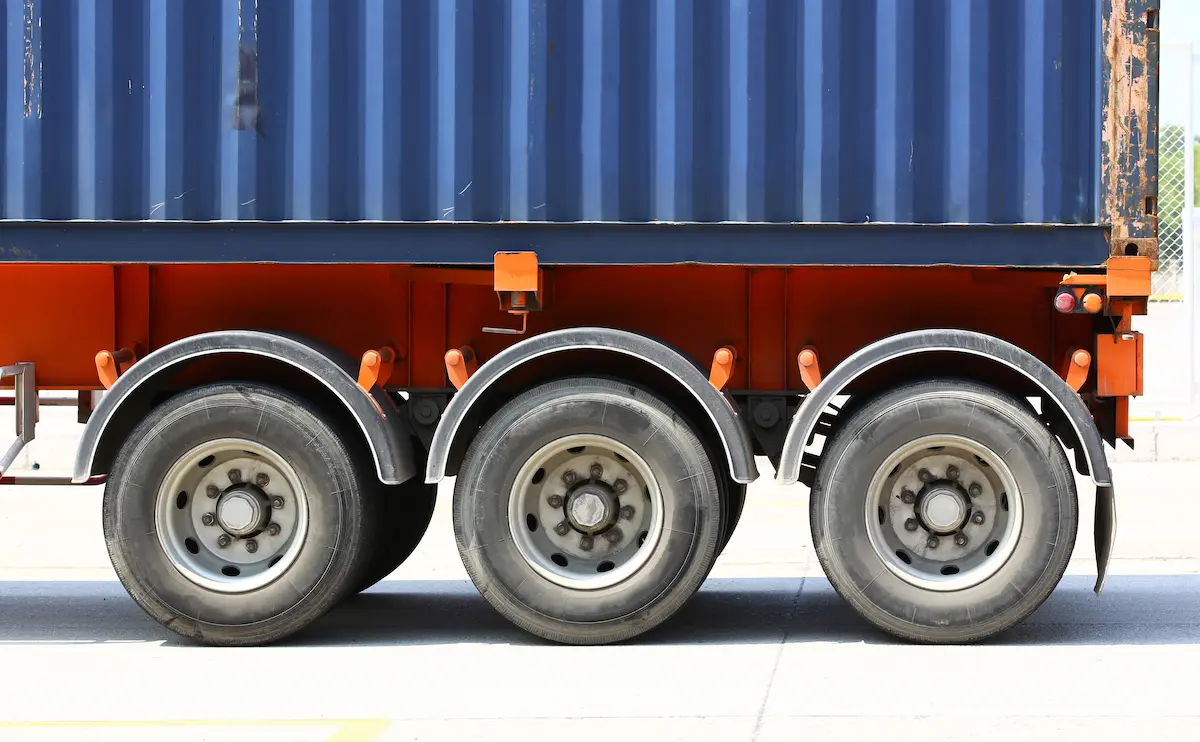
A trailer drops at a dock on Tuesday and gets hooked by a different driver on Friday. Nobody owned it in between. Nobody walked it. The defect that shows up at a scale on Monday has been there since last week, and the driver who gets the citation never saw the trailer before that morning.
That gap is the whole problem with trailer maintenance. Tractors have a driver attached to them every day. Trailers sit.
Enforcement does not make the same distinction. Federal rules treat every unit in a combination as its own vehicle. Under the periodic inspection requirement, a tractor, semitrailer, and full trailer combination means the tractor, the semitrailer, and the full trailer, including the converter dolly, must each be inspected. Your trailers are inspected as hard as your power units and maintained on a fraction of the budget.
Here is where that shows up.
Lighting is worth understanding precisely, because it gets described badly.
In the 2026 International Roadcheck, lighting accounted for 1,659 out-of-service violations, or 11.9 percent, ranking behind brakes, tires, and cargo securement. So lighting is not the leading out-of-service category. What it is, separately, is the most frequently recorded roadside violation overall, because most lighting defects get written as citations without an out-of-service order. High volume, lower severity.
That combination is exactly what makes it worth fixing. These are cheap defects that accumulate on your record.
The requirements for lamp quantity, color, position, and mounting sit in Subpart B of Part 393, with the specifics in Table 1 of 393.11, which ties back to FMVSS No. 108 as it existed when the equipment was built. Conspicuity is its own requirement: trailers 80 inches or more in overall width with a GVWR over 10,000 pounds, built on or after December 1, 1993, must carry compliant retroreflective sheeting. Faded, peeling, or missing sections of tape get cited, and nobody budgets for retaping a trailer.
Replacing a bulb and moving on is why the same trailer comes back with the same defect.
Grounds. The majority of repeat trailer lighting failures are ground problems, not lamp problems. A corroded ground at a lamp mount or crossmember produces intermittent operation that tests fine in a warm shop and fails in the rain. Chasing the bulb never fixes it.
The seven-way connector. Corroded pins, spread pins, and a worn socket at the nose of the trailer take out circuits in groups. Inspect and clean both ends, and replace the plug rather than bending pins back.
Chafe points. Wiring at frame crossings, near suspension movement, and at the rear frame wears through over years. That is a physical inspection, not an electrical test.
Moisture intrusion at housings. Sealed LED assemblies change the failure mode rather than eliminating it. When they fail, they usually fail at the connection rather than the diode.
Not every lighting defect carries the same weight. A cracked lens that still projects the required color and intensity is generally a warning. A single inoperative marker or clearance lamp is typically a citation. All stop lamps inoperative, all tail lamps inoperative, or both turn signals dead on one side moves into out-of-service territory.
The bigger exposure is what a visible defect invites. An inspector who sees a dead lamp has grounds to run a full inspection covering brakes, tires, coupling devices, and securement. A two dollar defect becomes a complete examination of a unit you were not prepared to have examined, which is the argument for getting equipment inspection-ready before an enforcement event rather than during one.
Trailer ABS is straightforward to get wrong because the compliance requirement is about signaling, not just stopping.
Under 393.55, each semitrailer, trailer converter dolly, and full trailer manufactured on or after March 1, 2001 must have an electrical circuit capable of signaling an ABS malfunction, with the means to connect that circuit to the towing vehicle. Trailers designed to tow another air-braked trailer must pass the malfunction signal forward. The section also covers exterior ABS malfunction indicator lamps for trailers.
Practically, that means the lamp is the item an inspector looks at, and a trailer whose ABS lamp does not work has a compliance problem whether or not the ABS itself is functional.
When the lamp stays lit, work the problem rather than clearing the code:
Clearing a code without finding the cause guarantees it comes back, usually at a scale.
Brakes account for the most vehicle out-of-service violations by a wide margin, and trailer brakes are a large share of that. Our breakdown of brake inspection requirements for fleet units covers the system in depth, so this section stays on what is trailer-specific.
Measure pushrod stroke rather than eyeballing it. An out-of-adjustment brake on a trailer with automatic slack adjusters is a signal that something upstream is wrong, and the periodic inspection standards are explicit that manually adjusting an automatic adjuster without first correcting the underlying problem is not acceptable. The underlying cause is often a distressed component elsewhere in the system: loose mounting hardware, cracked drums, worn bushings, broken welds.
Beyond that, check air line condition at every chafe point, spring brake function, and gladhand seals. Combinations are evaluated as a whole, which is why the defective brake threshold counts across the combination rather than per unit.
This is the area with the least ownership. The fifth wheel belongs to the tractor program, the kingpin belongs to the trailer program, and the interface between them belongs to nobody.
Landing gear. Bent or damaged legs, a seized or missing crank handle, missing pins, and a gearbox that has never been greased. Landing gear failures usually happen in the yard rather than on the road, which makes them an injury exposure more than a downtime exposure. A leg that collapses under a loaded trailer while someone is standing at the nose is a serious incident.
Kingpin and upper coupler. The minimum periodic inspection standards include locking mechanism parts that are missing, broken, or deformed to the extent that the kingpin is not securely held. Kingpin wear is measured, not judged by eye, and upper coupler plate condition, cracks, and loose mounting fasteners belong on the same inspection.
Put the coupling interface on someone's checklist explicitly. If it lives on neither the tractor PM nor the trailer PM, it is not being inspected.
Reefer trailers add their own service requirements on top of all of this, which we cover separately in refrigerated unit maintenance and compliance.
Mileage-based intervals fail on trailers because trailers do not accumulate miles predictably. A unit can run 8,000 miles in a month or sit at a customer yard for six weeks.
Trigger on events, not just odometers. Drop, pickup, yard dwell past a set number of days, and return from a customer location are all better triggers than a mileage threshold for equipment that spends time unattended.
Inspect at the terminal, in batches. Trailers parked in one yard are the easiest maintenance work in the fleet to do efficiently, because nothing has to be moved. A lighting and ABS sweep across 20 parked trailers takes a fraction of the time that 20 separate service events would.
Fix the annual inspection gap. Every unit in the combination needs its own periodic inspection, and the one most commonly missed is the converter dolly. Check your records for dollies specifically.
Make records follow the asset, not the terminal. Trailers move between locations and the maintenance history has to move with them, which is the same standard behind documenting inspections and repairs across terminals.
Set intervals by how the equipment is used. A dry van in regional service and a vocational trailer working off pavement should not share a schedule, for the same reasons we lay out in setting preventive maintenance intervals by vehicle type.
Account for where you operate. State inspection requirements vary, and carriers running multiple jurisdictions need to know which rules apply to trailers specifically. That is covered in our guide to state-specific inspection rules across operating regions.
The defects that land on your record are not exotic. They are lamps, grounds, connectors, and adjusters, and they are the same items that show up in the maintenance violations that cost fleets the most.
The practical obstacle is not knowing what to inspect. It is that trailers are scattered across yards and customer locations, and pulling them into a shop costs more in moves than the repairs cost.
We service trailers where they are parked, including lighting and ABS sweeps across a yard before a blitz week, annual inspections on units that never make it to a shop, and brake and coupling work on equipment that would otherwise sit out of service waiting for a bay.
If your trailers are getting inspected harder than they are getting maintained, schedule mobile trailer service at your yard and we will start with the units that have been sitting longest.


Torque™ by Ryder is a trademark of Ryder System, Inc. ©2025 Ryder System, Inc.

