
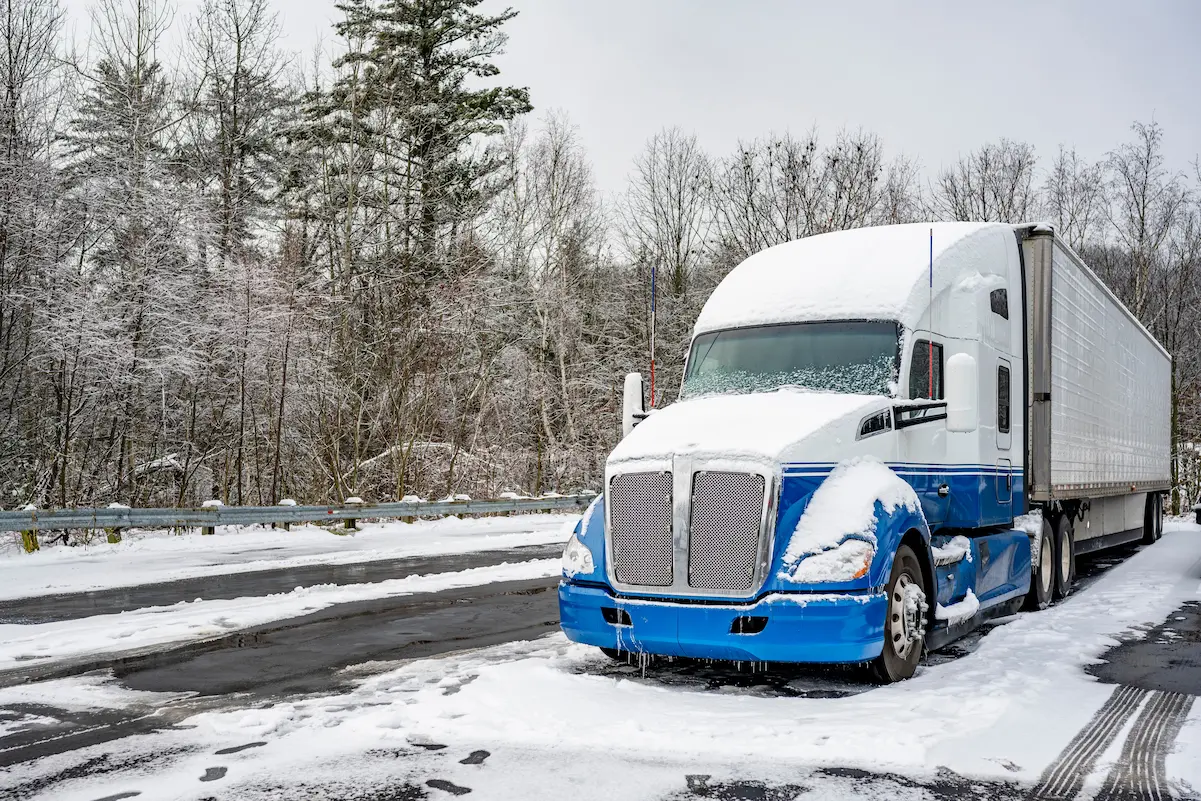
The first hard freeze of the season produces a cluster of no-starts, and almost none of them are actually a surprise.
A battery sitting at 60 percent of rated capacity cranks fine in September. At 15 degrees it does not. A fuel filter at the end of its interval passes enough fuel in October and plugs in December. An air dryer cartridge that has been saturated since summer tolerates moisture until the night that moisture turns to ice in a valve.
Cold weather does not create new failure modes. It exposes the marginal components you were already carrying. That is good news, because it means winter readiness is a service spec rather than a gamble.
Here is that spec, organized by system, with the temperatures where each problem starts.
Diesel contains paraffin wax that stays dissolved in warm weather and crystallizes as temperature drops. The process happens in three stages, and knowing which one you are in tells you what to do about it.
Cloud point is where wax crystals first become visible and the fuel takes on a hazy appearance. Equipment usually runs normally at this stage.
Cold filter plugging point is where the crystals grow large enough to accumulate in the fuel filter. The fuel still looks liquid, but flow is restricted, and this is where you see power loss, stalling, and no-starts. This is the stage most people mean when they say fuel gelled.
Pour point is where the fuel stops moving at all.
Where those temperatures fall depends on the blend, the region, and whether the fuel has been treated. Untreated No. 2 diesel starts clouding in the mid-teens and can begin plugging filters a few degrees below that. Do not run your winter plan on a number you found online. Ask your supplier for the cloud point and cold filter plugging point on the specific product they are delivering to you, which they publish and will provide.
Biodiesel blends change the math. Blends with smaller biodiesel percentages perform better in the cold, and fuel blenders combat crystallization by adding a cold flow improver in winter months. If you are running B20 in a cold region, the blend and the feedstock both matter, and that is a conversation with your supplier before the season rather than during it.
This belongs alongside the rest of your diesel maintenance fundamentals rather than sitting in a separate winter binder nobody opens.
DEF freezes, and that by itself is not a problem. The system was designed for it.
DEF freezes at approximately minus 12 degrees Celsius, around 11 degrees Fahrenheit. On a modern truck the tank is heated by engine coolant and the lines and dosing unit are electrically heated, and thawing is managed automatically by the ECM with no operator involvement. Frozen DEF does not prevent the engine from starting and does not cause a derate on its own.
What does cause a derate is a heater circuit failure. The system goes into derate when it detects a malfunction in one of those components, such as a tank heater or line heater. That distinction matters operationally, because it tells you where to look. A unit throwing DEF temperature codes in January has a hardware problem, not a weather problem.
Practical items:
That last point is where winter, idling, and aftertreatment intersect. Cold weather pushes drivers to idle, idling loads the aftertreatment, and the result shows up as a regeneration problem in February that had nothing to do with the emissions system being faulty. If you have not looked at what excessive idling costs in maintenance, winter is when that bill comes due, and it is worth reading next to keeping SCR and DPF systems compliant year round.
This is the winter failure fleets ignore most consistently, and it is the one that strands trucks.
An air system carrying moisture works fine in July. In January that same moisture freezes in lines, valves, and reservoirs. Brakes that will not release, a governor that will not cycle, and a trailer that will not charge are all downstream of water that should have been removed months earlier.
The air dryer is what removes it, and a saturated desiccant cartridge does nothing. Bendix recommends checking for moisture in the air brake system once a month, and adjusting cartridge replacement intervals downward when moisture shows up. Their guidance also separates high or sensitive air systems, meaning those consuming large volumes of air or sensitive to contamination such as vehicles with automated manual transmissions, from standard applications, with shorter intervals for the former. The vehicle OEM's published interval governs when it is more frequent than the component guidance.
Before winter:
Cold attacks the starting system from both directions at once. Battery capacity falls as temperature drops, while the engine takes more cranking effort to turn over because the oil is thicker. A battery that was adequate in September can be inadequate at 15 degrees without anything having changed about the battery.
Test before the season instead of replacing after the failure:
Our existing guidance on battery load testing and parasitic drain checks covers the testing methodology in more detail, and all of it applies with more urgency heading into winter.
Hand this to a technician. Each item lists the trigger temperature where it becomes urgent.
The problem with pre-winter service is not the work. It is that the work competes with revenue in the last quarter of the year, which is exactly when most fleets can least afford to pull units.
We run pre-winter inspections and service at your yard, on your schedule, so units go into the season checked rather than getting checked after the first failure. That includes fuel system service, air dryer and reservoir work, battery and charging diagnostics, and heater circuit verification on the DEF system.
If you would rather plan the season broadly first, our overview of planning fleet operations around seasonal weather shifts covers the strategy side. When something does go down mid-season, emergency protocols when a unit goes down will get you through it faster than a phone tree.
Otherwise, get mobile diesel service scheduled at your yard before the first freeze, and see what else our diesel service capabilities cover.


Torque™ by Ryder is a trademark of Ryder System, Inc. ©2025 Ryder System, Inc.

