
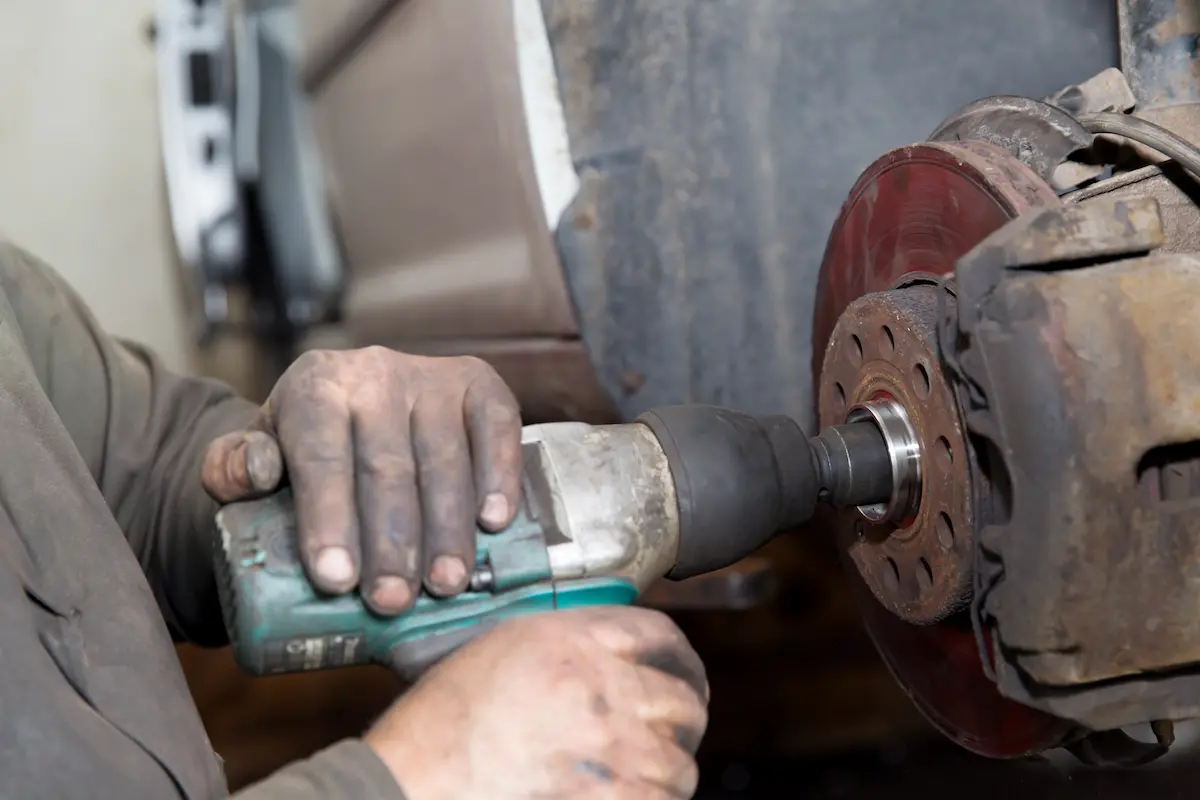
A wheel separation is one of the few maintenance failures that becomes a legal event rather than just a repair order. It also almost never happens without warning.
The chain is predictable. A seal starts to weep. Someone wipes the hub down and notes it as minor. Lubricant level drops below the bearing. The bearing runs hot, loses its film, and begins to wear. Endplay opens up past spec. Eventually the assembly comes apart, usually at highway speed, usually in traffic.
Every step in that chain is visible during a routine preventive maintenance service. What separates fleets that catch wheel-end problems from fleets that do not is rarely equipment or budget. It is whether the technician knows what the seal is telling them, and whether anyone is measuring endplay instead of guessing at it.
A wheel end is a system made of three interdependent parts: the bearings, the lubricant, and the seal. Change any one of them and you change how the other two behave.
The seal is the one most often misunderstood. It is designed to be the weakest element in the assembly, and that is intentional. When something goes wrong inside the hub, whether that is excessive heat, contamination, or a bearing beginning to break down, the seal fails first and tells you. Treating a seal leak as a cosmetic problem discards the one warning the system was engineered to give you.
Before a technician touches a wheel end, they need to know which type they are working on, because the service procedure is different for each.
Adjustable assemblies use a traditional inner and outer bearing with manual bearing adjustment. Endplay is set by the technician during installation.
Pre-adjusted assemblies can be identified by a spacer between the inner and outer bearings. That spacer sets a fixed dimension for preload, so adjustment is achieved when the retention hardware is torqued to spec rather than by the technician dialing it in. The bearings and seals may arrive loose or already pressed into the hub. These are generally field serviceable, but the manufacturer's service recommendations govern.
Unitized assemblies arrive from the factory as a sealed unit with bearings, seals, and lubricant already installed and verified. Bearing adjustment was set at the factory. The technician torques the spindle nut to the installation spec and the assembly is correct. Opening a unitized hub in the field usually defeats the purpose of running one.
The most common wheel-end mistake we see is a technician applying an adjustable-assembly procedure to a pre-adjusted or unitized hub. The Technology and Maintenance Council publishes separate recommended practices covering each configuration, and the axle manufacturer's documentation takes precedence over shop habit in every case.
Not every trace of oil at a wheel end is a leak.
Oil residue at the vent area is normal. It indicates the system is venting the way it was designed to, and it should not be recorded as leakage. Technicians who write up every damp hub cap generate noise that trains everyone to ignore the real ones.
A genuine seal leak looks different. You will see oil tracking down the backside of the wheel, on the tire sidewall, on the inside of the rim, or pooled on the brake components. Once it reaches the brake, you have two problems instead of one, because a contaminated lining does not recover and the affected wheel end loses braking effectiveness. That turns a lubrication issue into a stopping-distance issue, which is the connection to brake inspection requirements for fleet units that most inspection programs miss.
There is a second failure path that does not involve losing lubricant at all. A compromised seal lets water, road chemicals, and abrasives into the hub. The lubricant level looks fine. The lubricant itself is finished. In coastal and heavily salted regions, contamination failures outnumber loss-of-lubricant failures, which is one more reason salt and corrosion exposure in coastal operations changes what a maintenance interval should look like.
When we find an active leak in the field, the decision is not whether to repair it. It is whether the unit can be moved to a safe location first. A wheel end that is leaking and hot does not get scheduled for next week.
Three things matter, and technicians tend to check only the first.
Level. Read the hub cap sight glass with the truck on level ground. A unit parked on a crowned yard or a sloped lot will read wrong in both directions depending on which side you are looking at. Oil-lubricated wheel ends have a fill line for a reason, and both overfilling and underfilling cause problems.
Type. Wheel-end lubricants carry specifications. Oil, whether synthetic or mineral, should meet SAE J2360 requirements or API GL-5 or MT-1 guidelines. Common weights in service include 75W-90, 80W-90, 80W-140, and 85W-140. The specific requirement comes from the axle manufacturer. Mixing lubricant types, or topping off an oil-lubricated hub with whatever gear oil is open on the bench, is a documented cause of premature failure. So is introducing grease into a system designed for oil.
Condition. A milky appearance means water intrusion. Metallic content or glitter in the oil means a bearing is already coming apart, and the hub needs to come off now rather than at the next service. Darkening beyond normal means heat.
Recording lubricant condition rather than just checking a box is what makes the record useful later. That is the same standard that applies to documenting inspections and repairs across terminals generally, and wheel ends are where it pays off fastest.
For manually adjustable wheel ends, endplay is the number that determines bearing life.
The Technology and Maintenance Council target is .001 to .005 inch. That is one to five thousandths, and it cannot be assessed by hand. Reaching it requires a calibrated dial indicator with its magnetic base affixed to the hub or brake drum. A technician who checks endplay by grabbing the tire at twelve and six o'clock is not measuring anything. They are confirming that the wheel is still attached.
The widely used adjustment sequence is the 2-1-1 method:
Then verify with the dial indicator. The verification step is not optional, because the method gets you close and the measurement confirms you are actually in spec.
Too much endplay lets the bearing move and hammer itself. Too little creates preload, which generates heat continuously and shortens bearing life in a way that shows up as a roadside failure months later with no obvious cause. Both conditions are invisible without measurement.
Fastener torque is where a wheel-end job either holds or comes apart.
Use the manufacturer's published value. As one example, Webb publishes a recommended oiled torque of 450 to 500 ft-lbs for M22 x 1.5 studs with two-piece flange nuts. That value assumes lubrication: two drops of 30 weight oil between the nut and the nut flange, and two drops on the outermost two or three threads of the stud. Applying a dry-torque value to a lubricated fastener, or a lubricated value to a dry one, produces clamp load that is wrong in a way the torque wrench will not tell you.
A few things that belong in the written procedure:
The retorque step is the one fleets skip most often, usually because the truck left the yard and nobody owns the follow-up. Build it into dispatch rather than hoping the driver remembers.
Wheel ends are a fast visual read for anyone who does this for a living.
Federal requirements for wheel and rim condition fall under 49 CFR 393.205. An inspector is looking for loose, missing, or damaged fasteners, cracks radiating from stud holes, elongated stud holes, and visible lubricant on the wheel, rim, or tire sidewall.
The compounding problem is what a visible defect triggers. An oily wheel is a reason to look closer, and looking closer means a full inspection covering brakes, tires, coupling devices, and securement. In the 2026 International Roadcheck, inspectors conducted 54,575 inspections and placed 10,350 vehicles out of service, with brake-related conditions accounting for 39.1 percent of vehicle out-of-service violations and tires accounting for 20.9 percent. A wheel-end leak that puts a technician's eyes on the brakes and tires of that unit is not a small exposure.
The violation also follows the carrier rather than the truck, which is the part that surprises fleets new to this. That is worth understanding alongside the maintenance violations that cost fleets the most and worth acting on before a blitz week rather than during one, which is the whole argument for getting units inspection-ready before an enforcement event.
Wheel ends do not need a separate program. They need to be specified correctly inside the one you already run.
Every service, including the quickest one: visual check for leakage at each wheel end, lubricant level at the sight glass, fastener condition, and a hand check for heat after a run. A wheel end noticeably hotter than its opposite number on the same axle is telling you something before any instrument does.
Intermediate services: lubricant condition assessment, hub cap and vent condition, and a look at the tire for the irregular wear patterns that point back to a bearing or alignment problem rather than to inflation. That connection is why a tire program that catches irregular wear early doubles as wheel-end monitoring.
Major services: endplay measurement with a dial indicator on adjustable assemblies, recorded as a number.
Interval depends on duty cycle, not on the calendar. High-torque, stop-and-start, heavy-haul, and off-pavement work loads wheel ends differently than line haul, which is the same logic behind setting preventive maintenance intervals by vehicle type rather than running one schedule across a mixed fleet.
On rebuild versus replace, be honest about what a rebuild costs. By the time you account for components, labor, the additional hours the unit sits, and the liability attached to the repair if it fails, a complete assembly replacement is frequently the better number, and it often carries its own warranty coverage. A technician who is not trained to evaluate whether a hub casting, spindle, or set of studs is fit for reuse should not be making that call at all.
Wheel-end work done right requires calibrated torque equipment, a dial indicator, the correct lubricant on the truck, and a technician who knows which of the three assembly types they are looking at. Our mobile units carry all of it, and we service wheel ends where your equipment sits rather than sending it across town and losing a day.
If your last several wheel-end failures came as a surprise, the problem is usually the inspection spec rather than the parts. Talk to us about mobile wheel-end service at your location, or about what happens when a unit goes down unexpectedly and you need an emergency response protocol instead of a phone tree.


Torque™ by Ryder is a trademark of Ryder System, Inc. ©2025 Ryder System, Inc.

